
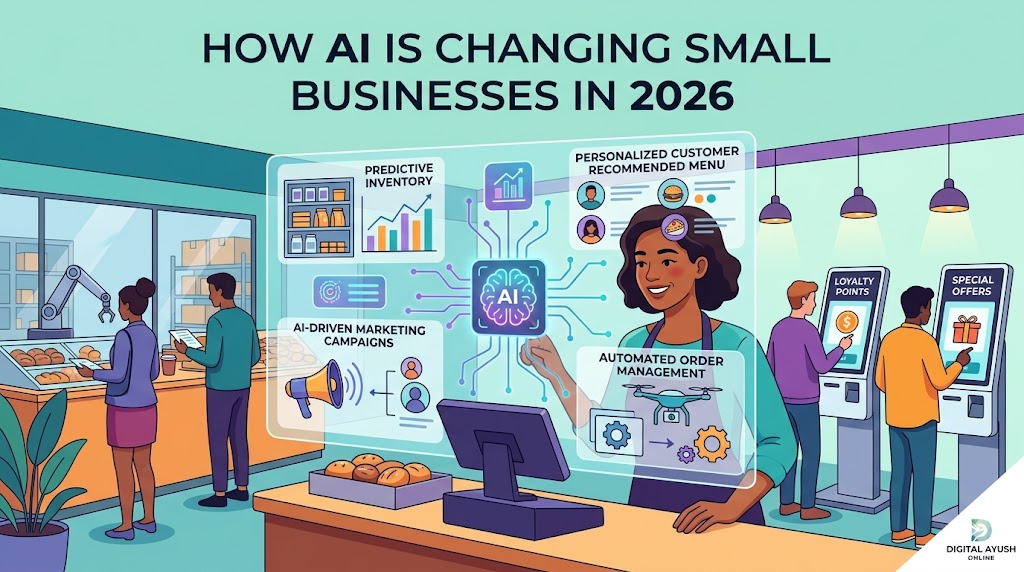
How AI Is Changing Small Businesses in 2026
Artificial Intelligence (AI) is no longer a technology reserved for large corporations with massive budgets. In 2026, small businesses are increasingly adopting AI-powered tools to streamline operations, improve customer experiences, and compete more effectively in the digital marketplace.
Key Ways AI Is Transforming Small Businesses
1. Customer Support Automation
AI-powered chatbots and virtual assistants can handle customer inquiries 24/7. They can answer common questions, process orders, and direct customers to the right resources, reducing response times and improving customer satisfaction.
Benefits:
- Faster customer support
- Reduced workload for staff
- Round-the-clock availability
2. Smarter Marketing Campaigns
AI helps businesses create personalized marketing campaigns by analyzing customer behavior and preferences. It can suggest content ideas, optimize email campaigns, and identify the best times to reach potential customers.
Benefits:
- Better customer targeting
- Higher engagement rates
- Improved return on marketing investment
3. Content Creation and Management
Many small businesses use AI tools to generate blog posts, social media captions, product descriptions, and marketing materials. While human oversight remains important, AI can significantly speed up content production.
Benefits:
- Saves time
- Increases content output
- Reduces content creation costs
4. Data Analysis and Business Insights
AI can analyze large amounts of business data and provide actionable insights. Small business owners can identify trends, forecast sales, and make more informed decisions without needing advanced analytical skills.
Benefits:
- Better decision-making
- Improved forecasting
- Enhanced business planning
5. Inventory and Supply Chain Management
Retailers and e-commerce businesses are using AI to predict demand, manage inventory levels, and reduce waste. AI can help ensure that popular products remain in stock while minimizing excess inventory.
Benefits:
- Lower operational costs
- Improved inventory accuracy
- Reduced stock shortages
6. Financial Management
AI-powered accounting and bookkeeping tools can automate invoicing, expense tracking, and financial reporting. This reduces manual work and helps business owners maintain accurate financial records.
Benefits:
- Increased efficiency
- Fewer accounting errors
- Better financial visibility
Challenges of AI Adoption
Despite its advantages, AI implementation comes with challenges:
- Initial learning curve for employees
- Data privacy and security concerns
- Dependence on technology providers
- Need for human oversight and quality control
Businesses should adopt AI strategically and ensure that employees are trained to use these tools effectively.
Future Trends for Small Businesses
Looking ahead, AI is expected to become even more integrated into daily business operations. Emerging trends include:
- AI-powered business assistants
- Advanced customer personalization
- Predictive analytics for decision-making
- Voice-based AI interfaces
- Automated workflow management
Small businesses that embrace these innovations early may gain a significant competitive advantage.
Conclusion
AI is transforming the way small businesses operate in 2026. From customer service and marketing to financial management and inventory control, AI offers practical solutions that improve efficiency and support growth. While challenges exist, the benefits often outweigh the risks when AI is implemented thoughtfully.
For small business owners, the question is no longer whether AI will impact their business—it’s how they can use it effectively to stay competitive in an increasingly digital world.
SEO Keywords: AI for small businesses, artificial intelligence 2026, AI business automation, AI marketing tools, small business technology trends, AI productivity tools, future of AI in business.