
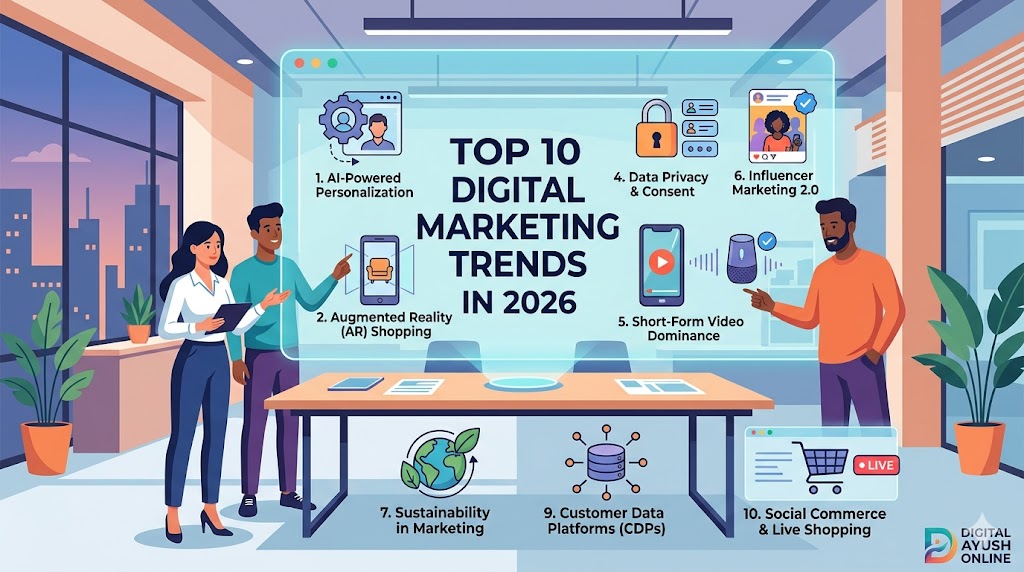
1. AI-Driven Marketing Becomes the Core Engine
Artificial intelligence is no longer just a supporting tool—it is the backbone of modern digital marketing in 2026. Brands now rely heavily on generative AI for content creation, customer segmentation, ad optimization, and real-time decision-making.
Companies like OpenAI, Google, and Adobe are leading this transformation. Marketers use AI to generate ad copies, product descriptions, email campaigns, and even video scripts in seconds.
The biggest shift is toward “AI co-pilots” that assist marketers in planning full campaigns, predicting outcomes, and automatically optimizing performance across platforms.
2. Hyper-Personalization at Scale
In 2026, personalization goes far beyond simply adding a customer’s name to an email. Brands now use predictive analytics and behavioral data to deliver highly individualized experiences in real time.
Platforms like Amazon and Netflix have set the standard by recommending products and content based on deep learning models that analyze browsing behavior, purchase history, and engagement patterns.
Marketers are increasingly using AI-driven customer journey mapping to anticipate needs before users even express them, making marketing feel almost “invisible” but extremely relevant.
3. Short-Form Video Dominates All Platforms
Short-form video continues to dominate digital attention spans in 2026. Platforms like TikTok, Meta (Instagram Reels and Facebook), and YouTube are the main distribution channels for viral content.
Brands now prioritize “video-first” strategies, where campaigns are designed for 10–60 second storytelling rather than long-form content. The emphasis is on authenticity, fast hooks, and mobile-first creative formats.
Even B2B marketing has adopted short-form video for thought leadership, product demos, and customer testimonials.
4. Voice and Conversational Search Optimization
With the rise of smart assistants and AI search interfaces, voice search is reshaping SEO strategies. Consumers now interact with search engines in conversational language rather than typed keywords.
Google continues to evolve its AI-powered search systems, while Amazon expands the use of Alexa-based shopping and voice commerce.
Marketers must now optimize content for natural language queries, question-based keywords, and AI-generated search summaries. This shift is also reducing the importance of traditional keyword stuffing and increasing the value of semantic SEO.
5. Social Commerce Becomes a Primary Sales Channel
Social media platforms are no longer just for engagement—they are full-fledged marketplaces. In 2026, users can discover, evaluate, and purchase products without leaving the app.
Meta, TikTok, and Shopify are heavily invested in integrating shopping experiences directly into social feeds.
Influencer-driven product tagging, live shopping events, and one-click checkout systems are driving massive conversion rates. This trend has blurred the line between entertainment and e-commerce.
6. Privacy-First Marketing and Cookieless Future
Data privacy has become one of the most important pillars of digital marketing. With stricter regulations and the gradual elimination of third-party cookies, brands must rely more on first-party data and consent-based tracking.
Google has been central to the transition away from third-party cookies in its Chrome ecosystem, while Apple has strengthened privacy features across iOS devices.
Marketers now focus on building trust through transparent data collection, loyalty programs, and value exchange strategies where users willingly share information in return for better experiences.
7. Evolution of Influencer Marketing into Creator Ecosystems
Influencer marketing has matured into a full creator economy ecosystem. Instead of one-off brand collaborations, companies now build long-term partnerships with creators across platforms.
Meta and TikTok provide monetization tools, while brands increasingly treat creators as strategic media partners rather than promotional channels.
Micro and nano influencers are becoming more valuable than celebrity endorsements because of their higher engagement rates and authentic audience connections.
8. Immersive Marketing Through AR and VR
Augmented reality (AR) and virtual reality (VR) are redefining how consumers interact with brands. In 2026, immersive experiences are used for product trials, virtual showrooms, and branded storytelling environments.
Meta is pushing the metaverse ecosystem, while Apple is advancing spatial computing experiences through devices like Vision Pro.
Retail brands are using AR for “try-before-you-buy” experiences, especially in fashion, furniture, and cosmetics, significantly reducing return rates and increasing buyer confidence.
9. Marketing Automation Powered by AI Agents
Marketing automation has evolved from simple email workflows to fully autonomous AI agents that manage campaigns end-to-end.
Platforms like Salesforce and HubSpot now integrate AI systems that can generate leads, nurture prospects, and optimize conversion funnels automatically.
These AI agents continuously test variations of ads, landing pages, and messaging, learning in real time to maximize ROI with minimal human intervention.
10. First-Party Data and CRM-Centric Strategies
As third-party tracking declines, first-party data has become the most valuable marketing asset. Businesses are investing heavily in CRM systems and customer data platforms to unify user information across touchpoints.
Salesforce and HubSpot play a central role in helping companies manage customer relationships, track behavior, and personalize communication.
Brands that successfully collect, analyze, and activate their own data are gaining a significant competitive advantage in targeting accuracy and customer retention.
Conclusion
Digital marketing in 2026 is defined by intelligence, automation, and deep personalization. Artificial intelligence, immersive technologies, and privacy-first strategies are reshaping how brands communicate with audiences. Companies that adapt quickly to these trends—especially those leveraging AI, social commerce, and first-party data—will dominate the digital landscape.
The future of marketing is not just about reaching customers; it is about predicting, personalizing, and participating in their digital lives in meaningful ways.